For much of modern history, the factory floor has been shaped by machines built around the tasks they perform. A welding robot is engineered to weld. A pick-and-place system is designed to pick and place. These machines are fast, repeatable, and highly effective within their defined boundaries. Change the task, however, and you often need a different machine entirely. Humanoid robots are beginning to challenge that model. By combining a humanoid form built for human environments with increasingly capable AI-driven control systems, they represent a fundamentally different approach to industrial automation, and the manufacturing industry is paying close attention.
Humanoid Robots: From Science Fiction to the Factory Floor
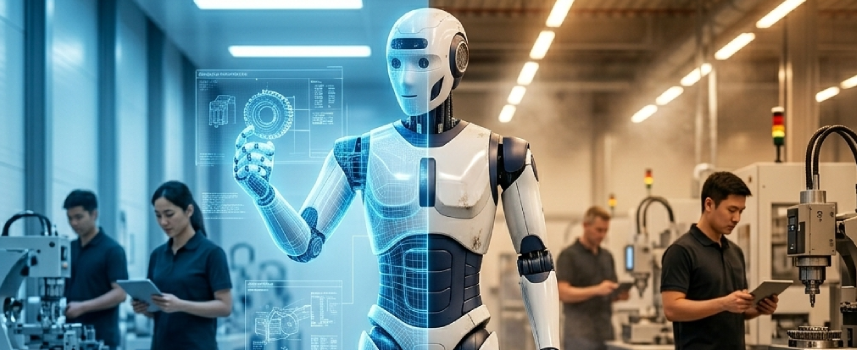
For most of the past century, the humanoid robot existed almost exclusively in the realm of science fiction. It appeared in films, novels, and television as a shorthand for technological ambition, a figure that looked like a person but moved like a machine. The gap between that cultural image and practical engineering reality was, for a long time, vast. What has changed over the past decade is the convergence of several technologies at once: advances in AI-driven perception, improvements in electric actuator design, and a far deeper understanding of how to build mechanical systems that can handle the physical demands of real production environments.
A humanoid robot is a machine resembling the physical structure of a human being, with a torso, two arms, two legs, and a head. The sophistication of each element varies considerably between platforms, but the underlying rationale for this design is deeply practical. Factories, warehouses, and assembly lines have been built to human scale. Workbenches sit at human height. Tools are sized for human hands. Walkways and doorways are proportioned for people, not machines. A robot that matches this geometry can, in principle, operate within existing infrastructure without modification, stepping into a workspace that already exists and beginning to contribute to it without the dedicated cells, safety enclosures, and purpose-built mounting points that conventional industrial robots require.
The development of commercially scalable humanoid systems has accelerated significantly in recent years. Robotics research that once seemed decades away from industrial use is now reaching the point where deployment in live production environments is a serious near-term consideration. The question is no longer whether humanoid robots will enter manufacturing. It is how quickly the technology will mature to support it at scale.
The Engineering Behind Safe Humanoid Robots
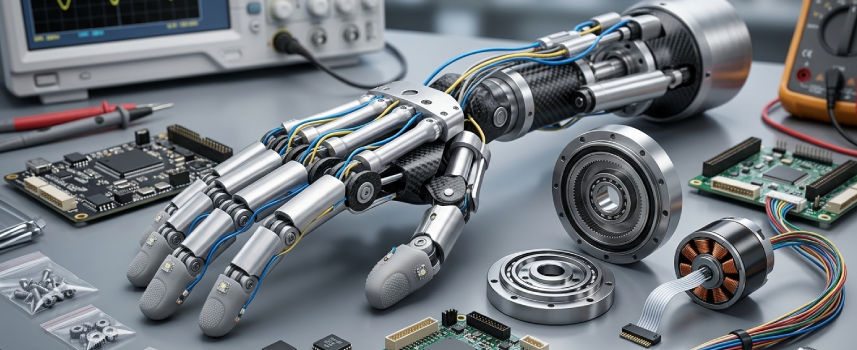
The performance of any humanoid robot depends entirely on the quality of its mechanical and electronic systems. Each joint, from shoulder to elbow, wrist to hip, knee to ankle, must deliver controlled, repeatable motion across a wide range of positions and loads. Precision bearings are central to making that happen. Thin-section bearings and crossed
roller bearings are widely used at rotary joints where space is constrained but load capacity and stiffness are critical. Four-point contact bearings appear in configurations that must handle combined axial and radial forces simultaneously, as is common at the shoulder and hip.
Electric actuators drive motion at each joint, and their integration with bearing arrangements determines both efficiency and service life. Many modern humanoid designs use series elastic actuators or quasi-direct-drive motors to achieve a degree of compliance in the joint, mimicking the give of biological muscle. This matters for safe operation alongside humans on the factory floor and for absorbing the impact forces that come with dynamic movement. The bearing assemblies in these joints must handle not just rotational loads but the oscillating stresses generated by real-world locomotion and manipulation.
Sensor integration adds a further layer of complexity. Force and torque sensors at the wrists and ankles, inertial measurement units in the torso, vision systems in the head, and tactile sensors at the fingertips all feed data continuously into the robot's control architecture. The control system processes this stream in real time, adjusting motor outputs across dozens of joints to maintain balance, navigate the environment, and handle objects with sufficient dexterity.
Coordinating all of this reliably across a full shift in a live production setting is where robotics engineering earns its complexity. Here at SLS Bearings, the demand we see from robotics engineers for precision bearing solutions reflects just how load-critical these joint assemblies are in practice.
Where Humanoid Robots Are Being Deployed
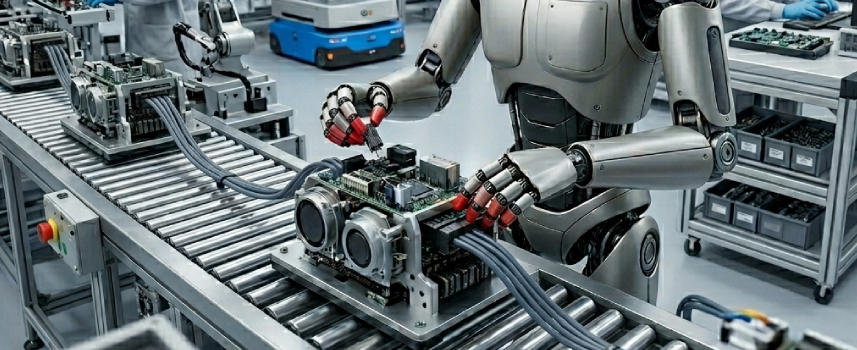
Automotive and electronics manufacturing are the two sectors furthest along in trialling humanoid robots, and the reasons are straightforward. Both industries run high-value, high-mix production environments where the cost of inflexibility is substantial.
In automotive assembly, humanoid robots are being evaluated for tasks such as fastening components in confined spaces, fitting interior trim panels, and handling sub-assemblies during line-side kitting. These tasks have historically resisted full automation because they require reach, dexterity, and visual judgment working in combination. Conventional robotic arms can replicate individual elements of that combination, but rarely all of them at once, at a cost that makes economic sense.
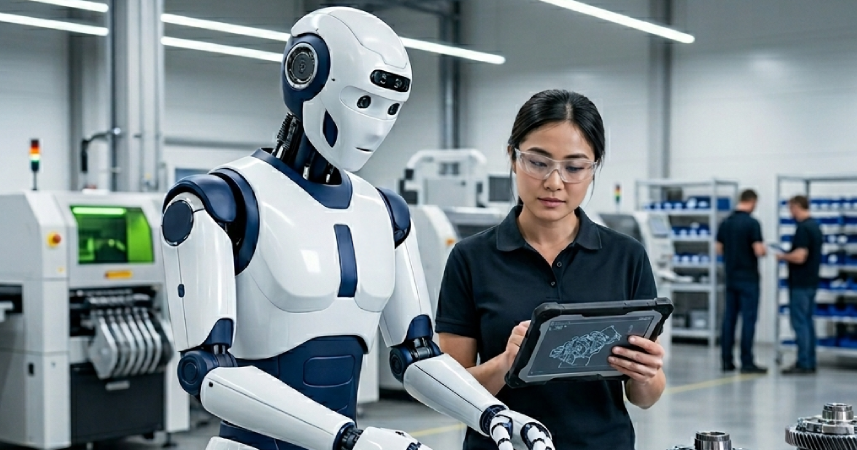
Electronics manufacturing presents a different set of challenges. Component handling at small scales, circuit board inspection, and cable routing all benefit from fine motor control and the ability to work in close proximity to delicate parts. The humanoid form factor allows robots to operate at standard benches alongside human technicians without requiring dedicated or segregated infrastructure.
Machine tending is another application gaining real traction. Loading and unloading CNC equipment, injection moulding machines, or stamping presses is repetitive work that suits robotic execution, and a humanoid system can move between multiple machine types across a shift rather than being fixed to a single station. The variety of tasks a humanoid robot can take on across a single facility is one of its most commercially compelling characteristics, particularly as manufacturers in countries like Europe, the UK, and Japan face ongoing labour pressure in mid-skilled production roles.
Advantages of Humanoid Robotics Over Traditional Industrial Robots
The most significant advantage a humanoid robot brings is task flexibility. A conventional industrial robot executes a specific motion profile from a fixed position. Changing its task typically means reprogramming, physical reconfiguration, or outright replacement. A humanoid system guided by AI-based perception and learning can be retrained for a new task considerably faster, and it can work in spaces that were never designed with automation in mind.
Safe collaboration with humans is a second meaningful advantage. Collaborative robots have spent the past decade demonstrating that it is possible to remove the physical barrier between human and robot workspaces. Humanoid robots extend this further, using force sensing and predictive motion control to operate alongside people without fixed safety fencing. This is particularly valuable in high-mix, low-volume environments where human adaptability remains essential and full automation is not a realistic outcome.
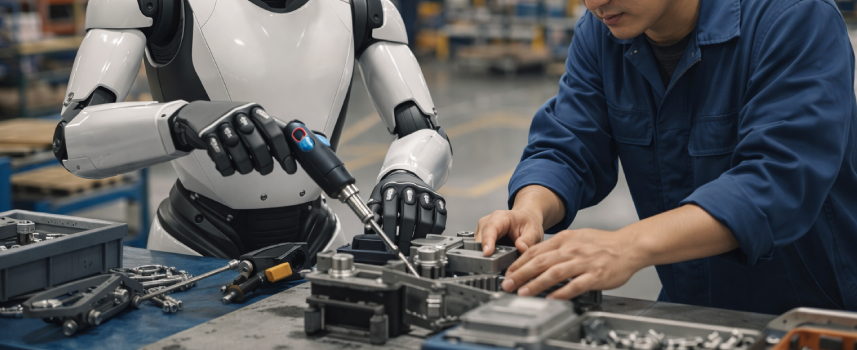
The ability to use standard tools and equipment also changes the economics of deployment. A humanoid robot that can pick up an existing hand tool, use a standard gauge, or operate equipment already on the floor does not require a facility to invest in custom end-effectors for every new task. Over time, that reduces capital expenditure and the engineering overhead that comes with maintaining a diverse fleet of purpose-built machines. For any company looking to start automating a greater variety of manual work, this flexibility makes the internal case considerably easier to build.
Preparing Your Facility for Humanoid Robot Integration
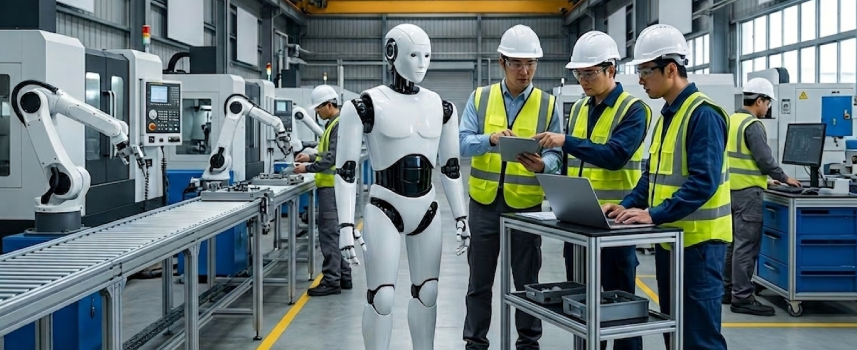
Integrating humanoid robots successfully is not simply a matter of acquiring a platform and beginning operation. Facilities need to assess their processes, their infrastructure, and their maintenance capabilities before deployment can deliver the expected results.
The starting point is an honest audit of the tasks you want to automate. Not every task is a good candidate for humanoid robotics at this stage of the technology's development. High-speed, single-axis repetitive work is still better served by conventional automation. The strongest cases are tasks currently performed by hand because they involve variability, confined spaces, or the need to switch between different operations within a single shift. Mapping your production floor against those criteria is the clearest way to identify where the return is likely to be strongest.
The mechanical ecosystem around the robot deserves equal attention. Humanoid systems place significant demands on their joint assemblies across continuous operational cycles, and the service life of those joints depends on careful bearing selection, correct lubrication, and a maintenance programme matched to the application. SLS Bearings'
robotic simulation capabilities give engineering teams the ability to model bearing performance under realistic load conditions before hardware is committed, reducing the risk of premature wear or unexpected downtime after deployment begins.
Workforce readiness is a third consideration that tends to be underweighted in early planning. Human-robot collaboration functions best when the people working alongside these systems understand what they can and cannot do. Structured training, clear protocols for task handover, and a process for continuous operational improvement all contribute to making integration stick over the long term.
Conclusion
Humanoid robots represent a significant shift in how manufacturers approach automation, particularly for tasks that demand flexibility, dexterity, and operation within human-designed environments. Successfully integrating these systems, however, depends on more than the robot itself. Careful assessment of application requirements, correct specification of mechanical components, and a maintenance strategy aligned with real operating conditions all play a critical role in ensuring long-term performance and reliability.
At SLS Bearings, we support automation engineers and manufacturers with a comprehensive range of precision bearing solutions and mechanical components designed for robotics and advanced industrial applications. From thin-section and crossed roller bearings to
linear motion systems and lubrication solutions, our offerings are engineered to meet the demands of complex, load-critical environments.
Our SLSPRO experts provide technical consultation, simulation support, and application-specific guidance to help you evaluate, specify, and maintain the right solutions for humanoid and advanced automation systems.
Contact SLS Bearings today to discuss your requirements and ensure your automation systems are built for precision, durability, and long-term operational success.

 sg
sg


 Hubungi Kami