Automation has reshaped food and beverage packaging across manufacturing industries over the past decade. Robot arms now handle everything from placing individual chocolates into trays to sorting bottles at high speed, bringing a level of consistency and precision that manual processes cannot reliably achieve.
Across different industries, robotic arm technology has become central to increasing productivity and maintaining the accuracy that high-volume food production demands. But deploying a robotic arm in a food or beverage facility is not as straightforward as selecting the right size or payload capacity. Daily washdown, food acid, airborne moisture, and strict contamination control all place demands on robotic systems that general-purpose automation is simply not built to handle. Every component that makes up a robotic arm in a food packaging environment needs to be chosen with hygiene in mind from the very start.
In this article, we cover the unique hygiene challenges of food and beverage packaging environments, the critical components that make up a food-grade robotic arm, common applications across the industry, and how to select the right components for your packaging line.
Why Food and Beverage Packaging Requires Different Types of Robot Arms
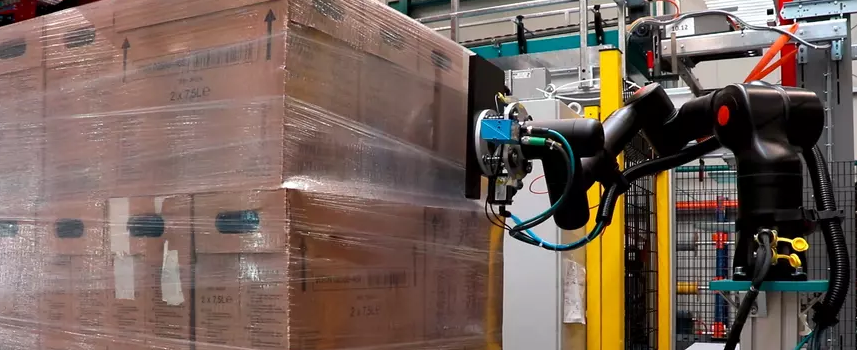
Modern food packaging lines use different types of robot arms depending on the task and the space available. Articulated robotic arms with multiple degrees of freedom carry out complex picking and placing movements across several axes, while simpler fixed-axis systems handle repetitive simple assembly work further down the line. Whatever their configuration, all of these systems operate in an environment that standard industrial robotics is not designed to withstand.
Food processing facilities are subject to hygiene regulations that cover every piece of equipment on the production floor, robotic systems included. Under standards such as FDA food safety regulations, EU food hygiene directives, or retailer-specific codes of practice, the materials and components inside automated equipment must pose no risk of contaminating the products being handled. That scrutiny extends to bearings, housings, actuators, lubricants, and surface finishes in ways that do not apply in most other industrial applications.
The consequences of getting this wrong are serious. A bearing seal that fails and releases non-food-grade lubricant onto a production line can trigger a product recall. Surfaces with microscopic crevices that trap bacteria will be flagged during hygiene audits.
Bearing units and
bearing housings that cannot survive high-pressure wash-down without letting in water or cleaning chemicals will deteriorate quickly, reducing the overall reliability of the system and pushing up maintenance costs. Getting the component specification right from the outset is the most cost-effective approach, and the one that best protects both production efficiency and food safety.
Critical Food-Safe Components for the Articulated Robot Arm
Stainless Steel Bearings
Stainless steel is the go-to material for most food-contact and food-proximate surfaces in robotic systems used in food manufacturing. It stands up to food acids, cleaning chemicals, and moisture without corroding, does not harbour bacteria the way porous materials can, and meets the surface finish standards that food facilities require.
Depending on the joint configuration and load requirements, robotic arms typically use
roller bearings and ball bearings in stainless steel sealed versions, both available in food-grade specifications suited to the demands of food manufacturing environments.
Standard carbon steel bearings corrode quickly in washdown environments, leading to premature failure and the risk of contamination from rust or bearing debris entering the product stream.
Sealed Bearings and Food-Grade Lubrication
Sealed, maintenance-free bearings keep contaminants out and lubricant in for long service intervals, supporting consistent repeatability and positional accuracy over time. Bearings that require regular relubrication present both a contamination risk during maintenance and a vulnerability to water and cleaning agents during operation. Where relubrication points do exist, only certified lubricants approved for incidental food contact should be used. Staying on top of lubrication and seal condition is one of the most practical ways to increase productivity and reduce unplanned downtime across robotic operations.
Servo Motors and End Effectors
The servo motors controlling joint movement and arm motion govern the speed, torque, and positional accuracy of every task the system performs. Any weakness in their protection rating will show up quickly during washdown. The end effector, the gripper or tool mounted at the tip of the arm, must also meet food-safe material requirements since it comes closest to the product itself. Clean external surfaces, food-compliant polymers, sealed cable runs, and easy integration with existing line control systems all contribute to a robotic arm that is highly reliable, straightforward to clean, and built for the demands of food manufacturing.
Robotic Arm Applications in the Food and Beverage Industry
Robot arms carry out a wide range of
material handling tasks in food and beverage facilities. Pick-and-place operations, where a robotic arm selects individual products like pastries or fruits and positions them into trays, cartons, or other formats, are among the most common tasks in food manufacturing. These systems run at high cycle rates across long continuous operations, so bearings and joints must maintain rotational precision and consistent motion throughout. Accuracy and repeatability are non-negotiable: even small amounts of positional drift affect throughput and assembly quality.
Collaborative robots, also known as
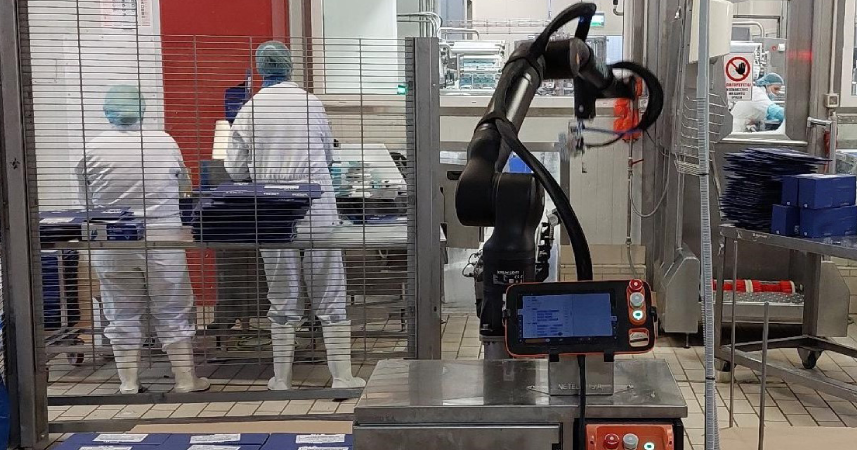
cobots, are increasingly common on food lines where the work changes frequently or requires more flexibility than fixed automation can offer. Designed to work safely alongside humans without the barriers that traditional industrial robotics requires, they are well suited to assembly tasks across different applications. Because collaborative robots work in closer proximity to people, the hygiene specification of their surfaces and joints receives particularly close scrutiny during audits.
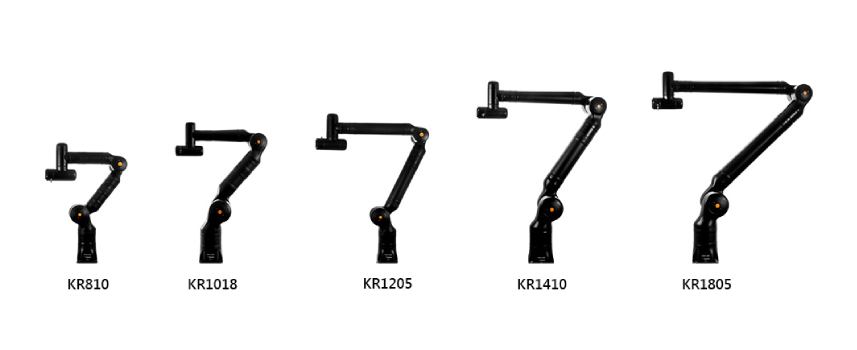
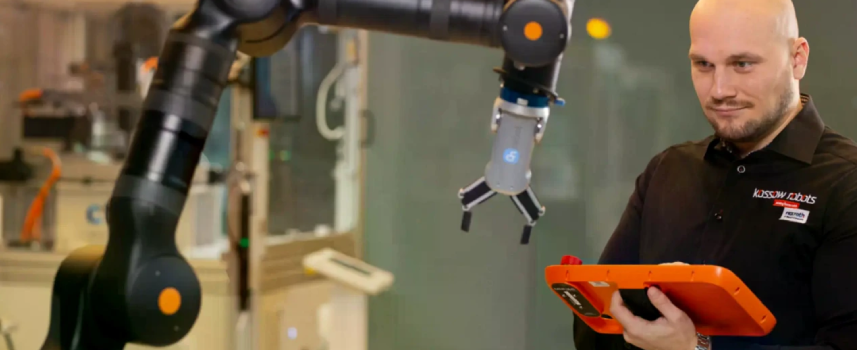
Here at SLS Bearings, we partner with Kassow Robots to supply a range of 7-axis collaborative robot arms developed for industrial use, offering a greater range of motion and improved precision compared to standard 6-axis designs.
Case packing and palletising involve heavier loads and more demanding operating cycles, with bearings and actuators rated for both payload and cumulative fatigue from repetitive movement. Food sorting and inspection lines increasingly integrate artificial intelligence, using AI-powered vision systems and sensors to identify, grade, and divert products at speed. These systems rely on precise arm control and consistent bearing performance to maintain positional accuracy.
Hygiene Standards and Maintenance in Food-Grade Robotic Systems
IP69K is the benchmark ingress protection rating for food-grade robotic equipment, indicating resistance to the high-pressure, high-temperature water jets used in food facility washdowns. Specifying IP69K-rated motors, sensors, and housings provides a solid baseline, but the rating only holds if washdown procedures are followed correctly. Using chemical
cleaners compatible with the materials and seals of the robotic system, at the right concentrations and temperatures, is just as important as the rating itself.
Food-grade lubrication is an operational necessity in food manufacturing environments. Standard industrial greases and oils are not suitable where incidental food contact is possible, and NSF H1 certified lubricants should be specified for every lubrication point on a robotic arm in these settings. Sanitation protocols should be developed with both the equipment supplier and the facility's hygiene team, with particular attention to motion planning for cleaning access. Making sure the robotic arm can be positioned to allow thorough cleaning of all surfaces and joints is a detail that is easy to overlook at installation but becomes a recurring problem if ignored.
Selecting Food-Grade Components
Specifying a food-grade robotic arm starts with the hygiene zone classification of each location where the equipment will be mounted. The degrees of freedom required, meaning how many axes of movement the arm needs to perform its tasks, determine how many joints, bearings, and servo motors are involved and therefore the full scope of the food-grade specification across the system. A six-axis articulated robotic arm deployed in a wet zone requires food-grade compliance across significantly more components than a simpler manipulator mounted in a dry area.
Material handling requirements, load, speed, duty cycle, and operating temperature all feed into component selection, but in food environments the hygiene zone classification should be established first. Robotics selection in food manufacturing also extends beyond mechanical components: the control architecture, sensors used for position feedback, and the software used to program motion sequences all need to align with the demands of the environment. Working with a supplier who understands both food-grade robotic systems and the regulatory landscape of food manufacturing significantly reduces the risk of misspecification.
Conclusion
Here at SLS Bearings, we support food and beverage facilities in selecting and sourcing the bearings and power transmission components that robotic systems across different industries demand. Visit our
Food & Beverage industry page to explore the range of food-grade solutions we supply, or
get in touch with our SLSPRO team to discuss the specific requirements of your robotic arm deployment.

 sg
sg



 Contact Us