Ball bearings are essential components that keep machinery running smoothly across countless applications. From household appliances to heavy industrial equipment, these precision-engineered parts reduce friction between moving components, extending equipment life and improving performance.
However, not all ball bearings are the same. Each type is designed to meet specific application requirements, handling different loads, speeds, and operating conditions. Understanding which bearing suits your needs can prevent equipment failure and ensure optimal performance, while selecting bearings from a reputable manufacturer such as SKF is important and can prevent equipment failure and ensure optimal performance.
This guide explores five common types of ball bearings and their applications.
Deep Groove Ball Bearings
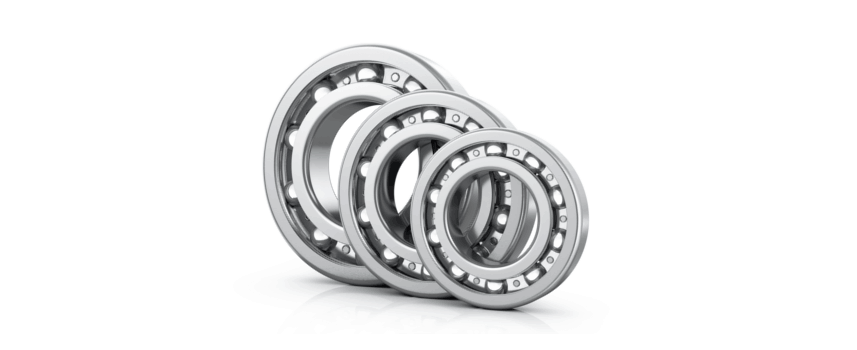
Deep groove ball bearings have deep raceway grooves that enable them to handle both radial and axial loads effectively. This design makes them the most widely used bearing type across industries. The deep grooves keep the balls securely positioned, allowing smooth rotation even under varying load conditions.
These bearings excel at high-speed operations while generating minimal friction and heat. Available in open, shielded, or sealed configurations, they can be adapted to different operating environments from clean factories to dusty workshops.
Common Applications
Deep groove ball bearings are often used in electric motors, household appliances, and
automotive components. You'll find them in industrial motors, washing machines, ceiling fans, and automotive wheel hubs. Their versatility makes them the go-to choice for standard operating conditions.
Angular Contact Ball Bearings
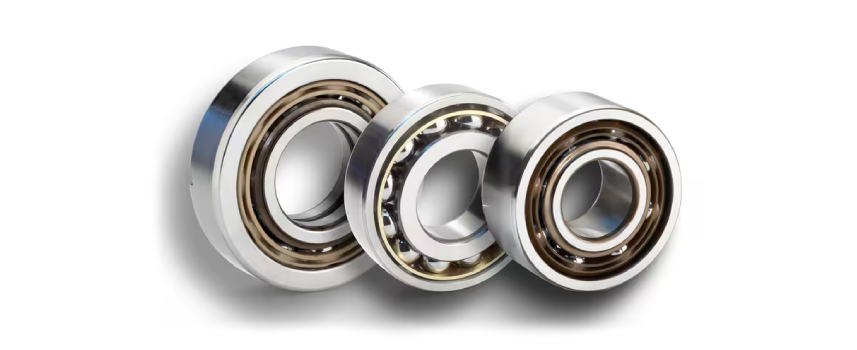
Angular contact ball bearings are designed with angular contact points between the balls and the raceways. This angled configuration allows them to support combined radial and axial loads more effectively than deep groove bearings, making them ideal for precision applications.
They come in various configurations, including single-row, double-row, and four-point contact designs. Single-row bearings handle loads in one direction, while four-point contact bearings manage bi-directional axial loads in a compact design.
High-performance variants, such as the SKF Explorer single row angular contact ball bearings, are manufactured to high precision accuracy classes and designed for universal matching with built-in preload. This simplifies installation, improves running accuracy, reduces lubricant consumption, and can significantly extend bearing service life in demanding applications.
Common Applications
Angular contact bearings are essential in high-precision machinery. CNC machine tool spindles depend on them to maintain tight tolerances during machining operations. Automotive transmissions use them to handle complex forces during gear changes. High-speed motors,
robotic systems, and dental equipment all specify these bearings when precision and rigidity are paramount.
They're often mounted in pairs to further increase stiffness and load-carrying capacity for demanding applications.
Thrust Ball Bearings
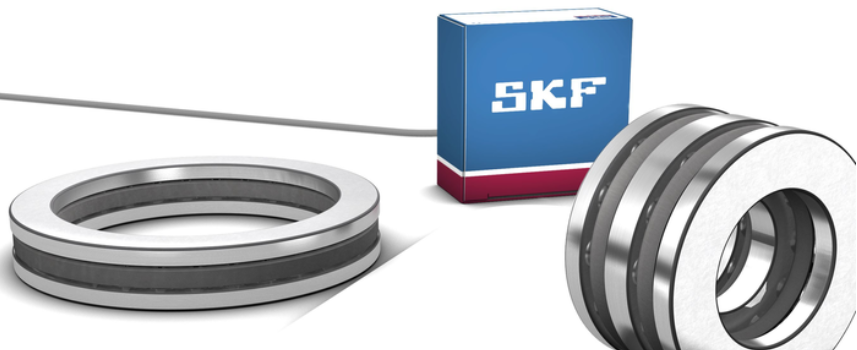
Thrust ball bearings consist of two grooved washers with balls positioned between them, creating a horizontal bearing configuration. Unlike radial bearings, thrust bearings are specifically designed to support axial loads—forces acting along the shaft axis.
These bearings are commonly used in applications where axial load capacity is essential. Their flat design allows them to support substantial vertical or pushing forces with minimal friction. However, they cannot handle radial loads, so they typically work with radial bearings in applications experiencing both load types.
Premium manufacturers such as SKF produce thrust ball bearings to strict international standards, ensuring consistent axial load handling and dependable performance across industrial applications.
Common Applications
Automotive clutch systems use thrust bearings as release bearings to handle engagement forces while allowing rotation. Crane hooks rely on them to support massive vertical lifting loads while allowing free rotation. Vertical pump shafts, rotary tables, and steering columns all depend on thrust ball bearings to manage axial forces efficiently. Industries often specify thrust bearings from established manufacturers such as SKF to ensure consistent axial‑load performance and long service life.
Self-Aligning Ball Bearings

Self-aligning ball bearings are made with two rows of balls and a spherical outer ring raceway. This unique design makes them suitable for reducing misalignment and shaft deflection, which are common challenges in real-world industrial applications.
The spherical outer raceway allows the bearing to automatically compensate for angular misalignment, typically up to 3 degrees. This reduces stress on the bearing and surrounding components, extending service life in challenging mounting conditions where perfect alignment is impossible to maintain.
Common Applications
Agricultural equipment like tractors and harvesters operates in demanding conditions with flexible frames. Self-aligning bearings accommodate frame flexing and shaft deflection that occurs during field operations. Long conveyor systems experience shaft deflection due to their length and loads. Wood processing equipment like sawmills generates heavy loads that cause shaft bending during cutting operations.
Textile machinery, paper mills, industrial fans, and
material handling systems all benefit from self-aligning bearings in environments where maintaining perfect alignment is impractical.
Insert Bearings (Y-Bearings): Easy Installation, Reliable Performance
 Easy Installation, Reliable Performance.webp)
Insert ball bearings are designed to be easily inserted into housings, eliminating the need for precision shaft machining. They feature a set screw or eccentric locking collar that secures the bearing directly onto the shaft.
These bearings are commonly used in applications like agricultural equipment,
conveyor systems, and mounted units where ease of installation is prioritised. Often supplied pre-mounted in pillow blocks, flange units, or take-up units, they create complete assemblies ready for bolt-on installation.
Common Applications
Conveyor systems use insert bearings extensively because maintenance teams can replace the entire unit in minutes without specialized tools. Agricultural equipment benefits from field-serviceable design—bearings can be replaced on-site during critical seasons using basic hand tools.
Material handling machinery, industrial fans, food processing equipment, and packaging systems all specify insert bearings for their balance of performance and convenience. The pre-lubricated, sealed design requires minimal maintenance.
Conclusion
Selecting the appropriate ball bearing type requires understanding your application's specific demands—load types (radial, axial, or combined), operating speeds, alignment challenges, space constraints, and environmental conditions.
Deep groove ball bearings offer versatility for general applications. Angular contact and four-point contact bearings provide precision for high-performance systems. Thrust ball bearings handle pure axial loads efficiently. Self-aligning ball bearings forgive installation imperfections and shaft deflection. Insert bearings deliver economical solutions where easy installation is paramount.
Making the right choice impacts performance, reliability, maintenance costs, and equipment life. A properly specified ball bearing runs quietly, requires minimal maintenance, and delivers years of dependable service.
Need help selecting the right ball bearing for your application? Our technical team partners with leading manufacturers like SKF to ensure you get quality ball bearing products that meet your exact requirements.
Contact SLS Bearings today for expert guidance on ball bearing selection and reach out to our SLSPRO team for personalised, professional recommendations.

 sg
sg


 Contact Us