Manufacturing is changing rapidly. Labour shortages are pushing factories to find new solutions. Humanoid robots are stepping in to fill the gap.
These human-shaped bipedal robots work alongside people in factories. They handle tasks that were once impossible for traditional robots. From automotive plants to electronics assembly, humanoid robots are proving their worth. Humanoid robots are often showcased on stage or in public demonstrations to highlight their capabilities.
This article explores what humanoid robots are, how they work, where they’re being used, and how to prepare your facility for this technology.
What Are Humanoid Robots and Why Factories Are Adopting Them
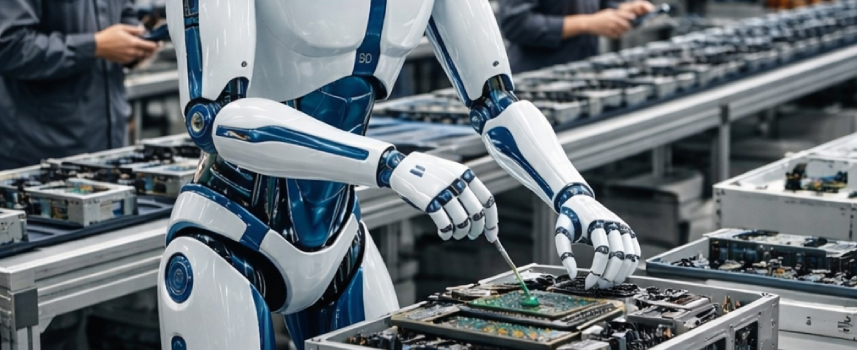
Humanoid robots are machines designed to look and move like humans. They have two arms, two legs, a torso, and a head with sensors. This shape, designed after the human body, isn’t just for show—it serves a practical purpose. Countries like China and Japan have played a significant role in the development and advancement of humanoid robots, leading innovation in
robotics technology and design.
Factories are built for human workers. Doorways, stairs, workbenches, and tools are all designed for human-sized bodies. Traditional industrial robots can’t navigate these spaces easily. Humanoid robots can. Most available humanoid robots have a high number of degrees of freedom, which allows for human-like movement but also increases the complexity and cost of their control systems.
Automotive companies are already testing humanoid robots in their factories. In addition, Chinese companies have developed advanced humanoid robots, contributing to the rapid progress in this field. These early adopters see clear benefits. The humanoid robots work in spaces that would cost millions to redesign for traditional automation.
The main driver for adoption is simple: labour shortages. Manufacturing facilities worldwide struggle to find enough workers. Humanoid robots fill positions that remain empty, keeping production lines moving.
Key Components That Make Humanoid Robots Work
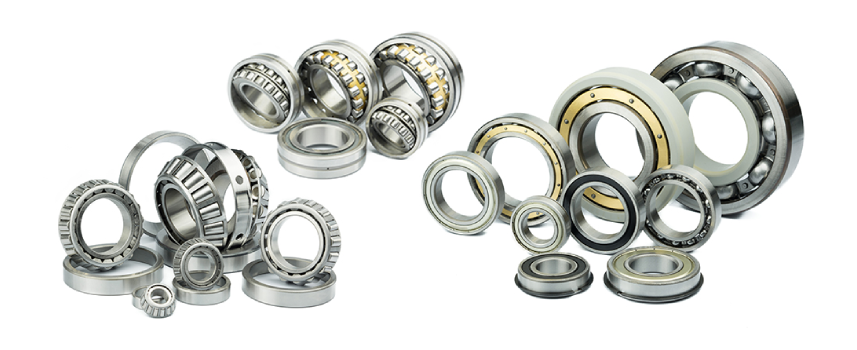
Precision bearings in joints enable smooth, accurate movement. Each joint in a humanoid robot contains high-quality
roller bearings that allow rotation without binding. These bearings must withstand millions of cycles whilst maintaining accuracy. Without reliable bearings, the robot’s movements become jerky and imprecise.
Electric actuators create the motion that makes robots move. These motors drive each joint, translating electrical signals into physical movement. Modern actuators provide enough force to lift industrial parts whilst remaining compact enough to fit inside human-scale arms and legs.
Electric actuators are the most popular type in humanoid robots, but they often require multiple units for a single joint due to power limitations.
Sensors give humanoid robots awareness of their surroundings. Vision systems, including cameras let them see parts and obstacles and recognize objects, people, and environmental cues. Touch sensors detect when they’ve grasped an object. Position sensors track exactly where each joint is at any moment.
Control systems coordinate everything. Advanced AI processes sensor data and decides how the robot should move. These systems learn from experience, improving performance over time. The AI handles thousands of calculations per second to keep the robot balanced and working efficiently. Maintaining balance is crucial for stable bipedal walking and navigation, and intelligence enables the robot to adapt and perform complex tasks autonomously.
Humanoid Robotics Applications in Modern Factories
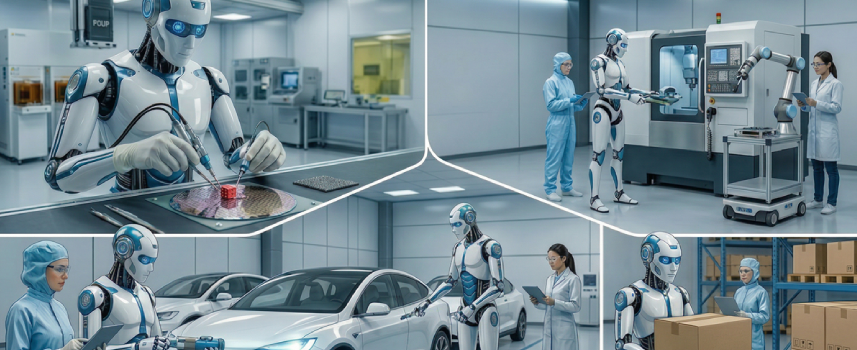
Assembly work is where many humanoid robots shine. They pick up parts, position them precisely, and insert them into assemblies. The robots handle these parts with millimetre-level accuracy. In addition to parts, humanoid robots can carry boxes, handle packages, and sort items, demonstrating their ability to operate in real-world warehouse and factory environments, such as in
food & beverage manufacturing.
Quality inspection tasks suit humanoid robots well. They can visually inspect products, check measurements, and identify defects. Their consistent attention doesn’t fade during long shifts. Some automotive manufacturers use humanoid robots to check door locks, headlights, and seat belts on electric vehicles.
Machine tending involves loading and unloading manufacturing equipment. Humanoid robots excel at this repetitive work. The robots work continuously without breaks. Companies utilise robots for manufacturing tasks in automotive plants. In many cases, humanoid robots work alongside other robots, such as robotic arms and autonomous mobile robots (AMRs), to carry out tasks like moving boxes, handling inventory, and supporting assembly lines.
Collaborative work alongside humans is increasingly common. Modern humanoid robots include safety features that let them operate near people. They pause when humans enter their work area. This collaboration combines human problem-solving with robotic consistency. Robots are also used in retail and hospitality as greeters, guides, and inventory managers, demonstrating versatility beyond manufacturing.
Automotive factories lead adoption because they face significant labour challenges. Electronics manufacturers are also testing humanoid robots for delicate assembly tasks requiring dexterity.
Advantages of Humanoid Robotics Over Traditional Industrial Robots
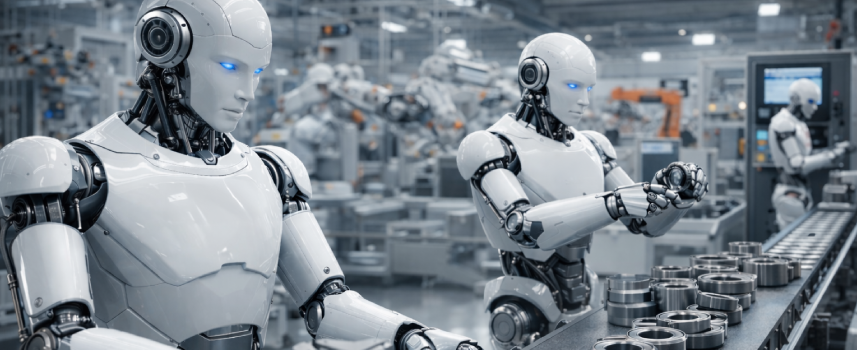
Humanoid robots offer several advantages that traditional factory robots can’t match:
- Flexibility is their biggest strength. Traditional robots need extensive reprogramming to switch tasks. Humanoid robots learn new tasks more quickly through AI training. A humanoid can build one product in the morning and a completely different one in the afternoon.
- Human-scale workspaces don’t need modification. Factories can deploy humanoid robots without redesigning assembly lines. They use existing workbenches, reach into existing storage, and navigate existing aisles. This saves millions in facility modifications.
- Safe collaboration with human workers is built into modern humanoids. They detect when people are nearby and adjust their behaviour. Traditional industrial robots typically require safety cages that separate them from workers. Humanoid robots work right alongside people.
- Task adaptability means one robot can handle multiple jobs. Traditional robots are specialists—each one does a single task very well. Humanoid robots are generalists, as they can switch between different tasks as production needs change. This versatility becomes valuable in facilities producing multiple product types.
Recent advancements in humanoid robotics have led to significant improvements in automation and the development of new skills, enabling these autonomous robots to perform increasingly complex tasks.
The cost consideration is also changing. Whilst humanoid robots currently cost more upfront than traditional robots, their versatility means fewer total robots are needed. The return on investment timeline has dropped significantly as the technology matures.
Challenges & Considerations of Humanoid Robots in Manufacturing
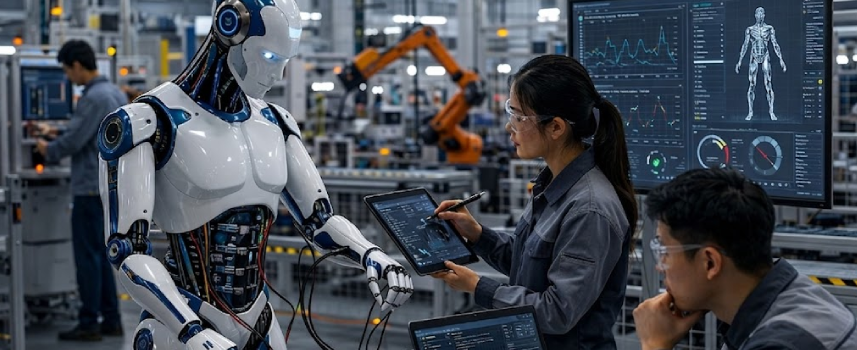
While the promise of humanoid robots in manufacturing is significant, there are important challenges and limitations to consider. One of the primary obstacles is the high cost associated with acquiring and deploying these advanced robots. For many manufacturers, the initial investment can be a barrier to adoption.
Additionally, humanoid robots require extensive programming and training to perform specific tasks effectively. Each new task may demand a unique set of instructions and adjustments, which can be time-consuming and require specialized expertise. This complexity means that integrating humanoid robots into existing workflows is not always straightforward, and ongoing support is often necessary to ensure optimal performance.
Safety Considerations When Integrating Humanoid Robots
Safety is a top priority when bringing humanoid robots into manufacturing environments. These robots are designed to interact closely with humans, so it’s essential to ensure that their movements and actions do not pose a risk to workers. Manufacturers must implement robust safety protocols, including emergency stop features, collision detection, and restricted operating zones.
Training workers on how to interact with humanoid robots is equally important. Employees should understand the robots’ capabilities and limitations, as well as the proper procedures for working alongside them. By fostering a culture of safety and awareness, manufacturers can minimise the risk of accidents and create a productive environment where humans and robots collaborate effectively. With the right safeguards in place, humanoid robots can enhance both safety and efficiency on the factory floor.
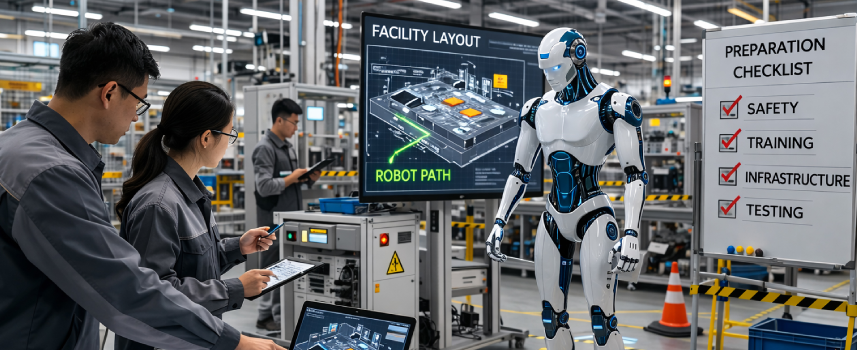
Preparing Your Facility for Humanoid Robot Integration
Conclusion
Humanoid robots represent an important step forward in manufacturing automation. Their ability to work in human-designed spaces while handling varied tasks makes them valuable for modern factories. As labour shortages continue, more facilities will adopt this technology.
The advantages are clear: flexibility to handle multiple tasks, compatibility with existing workspaces, safe collaboration with human workers through human-robot interaction, and adaptability as production needs change. Early adopters in automotive, semiconductor, and electronics manufacturing are already seeing benefits.
Here at SLS Bearings, we offer comprehensive
robotic automation solutions, from precision bearings for robot joints to technical guidance on component selection and maintenance support. Get in touch with us today to keep your robotic automation systems running reliably and efficiently. SLSPRO experts offer expert advice,
specialised services, and premium automation support for manufacturing and industrial clients.
Contact SLS for expert guidance on implementing humanoid robots and selecting the right precision components for your automation needs.

 sg
sg


 Contact Us